Echoes of Middle East Crisis to Reach Taiwan Strait
United Daily News Opinion, May 6, 2026
President Donald Trump of the United States has restarted navigation through the Strait of Hormuz under the banner of “Operation Liberty.” On the surface, this appears to restore order to international shipping, but in reality, it is pushing the U.S.-Israel-Iran conflict into an even more dangerous phase.
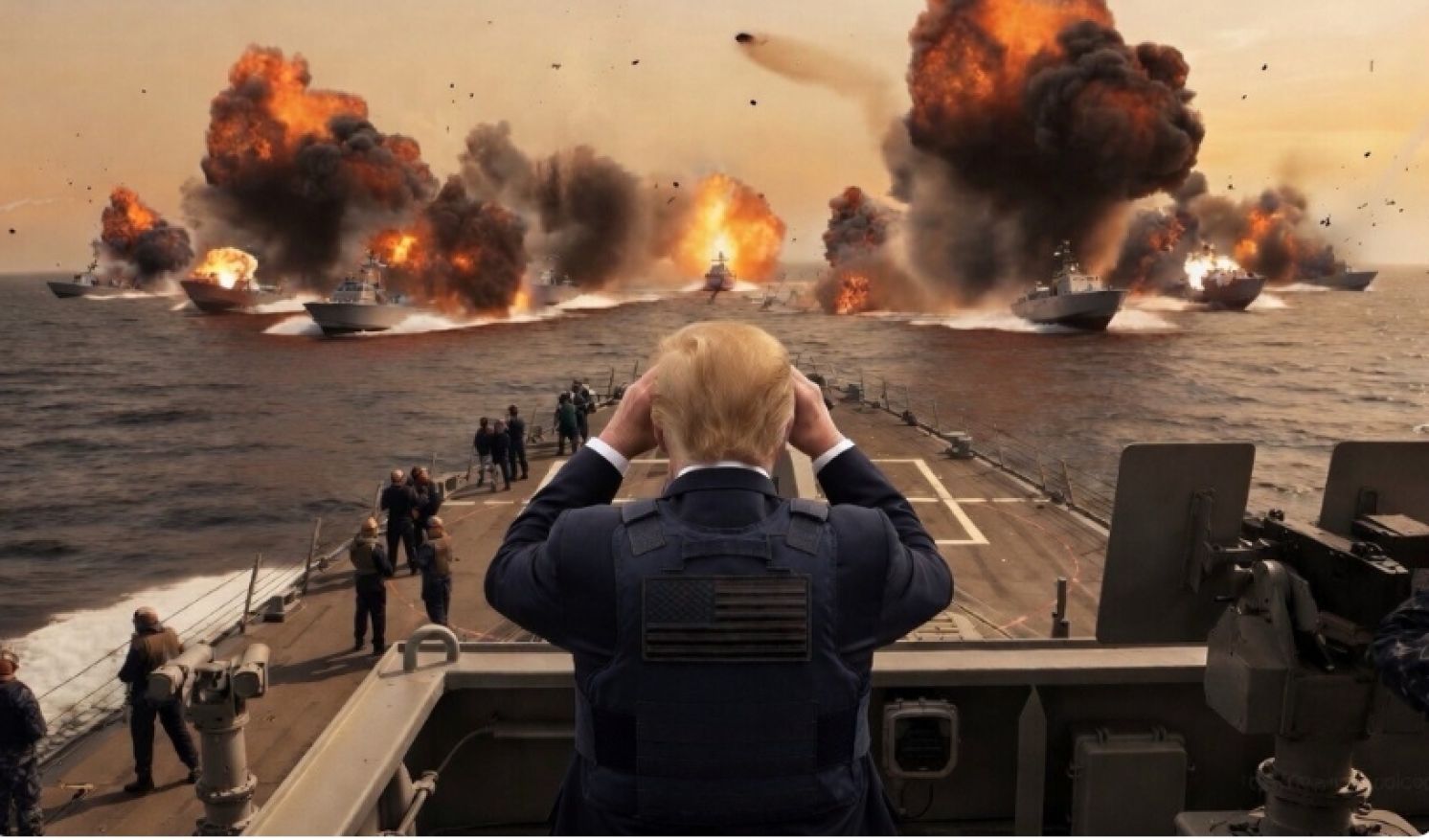
On May 4, Mr. Trump posted on Truth Social claiming that seven Iranian speedboats had been sunk. Meanwhile, Iran launched missiles and drones toward the United Arab Emirates and established a maritime control zone, demonstrating that the ceasefire exists only on paper while the strait itself has become the true battlefield. The most likely next stage is not full-scale war, but rather a prolonged, low-intensity yet high-risk maritime war of attrition.
Iran does not need to confront the American fleet head-on. By using speedboats, drones, naval mines, disinformation, and proxy attacks to drive up insurance costs, deter shipowners, and destabilize oil prices, it can already prove that the United States is incapable of maintaining order alone. The United States, meanwhile, may gradually shift from supporting freedom of navigation toward quasi-convoy operations. If additional merchant vessels, oil tankers, or U.S. naval ships are damaged, the White House would then have justification to expand military action. This is precisely the most dangerous aspect of the situation: neither side wants full-scale war, yet both need to demonstrate that they have not backed down.
Europe’s hesitation is also noteworthy. France is unwilling to join military operations with unclear structures, while Britain and France are separately pursuing alternative maritime security routes, showing that the Western alliance is not entirely united. If Washington cannot transform the reopening of the strait into a humanitarian mission aimed at rescuing 20,000 stranded sailors, it will struggle to gain international legitimacy. Conversely, if Iran obstructs humanitarian evacuations, global public opinion may shift toward supporting the United States. In other words, the next key factor will not be who possesses stronger firepower, but who first secures the position of guardian of order.
Beijing will undoubtedly notice this opening. China has energy, shipping, and diplomatic interests in the Persian Gulf and will likely take advantage of Washington being deeply entangled in the Middle East to test America’s commitments in the Indo-Pacific.
Before Mr. Trump’s anticipated meeting with Chinese President Xi Jinping in mid-May, Mr. Trump may ask Mr. Xi to restrain Iran in exchange for concessions related to tariffs, technology restrictions, or geopolitical issues. Beijing, meanwhile, may package Middle East stabilization as evidence of great-power responsibility while simultaneously probing whether Washington is willing to lower its profile on the Taiwan issue.
This is exactly where Taiwan must remain most vigilant. The Middle East crisis will not automatically strengthen security in the Taiwan Strait; rather, it may push Taiwan toward the margins of the negotiating table.
At this moment, Taiwan should guard against three major risks. First, it must guard against disruptions to energy and industry. If instability in the Strait of Hormuz becomes prolonged, then rising oil prices, natural gas costs, freight rates, and insurance premiums will all transmit into Taiwan’s prices and industrial supply chains. The government must immediately review strategic oil reserves, natural gas inventories, alternative shipping routes, and the supply capacity of critical materials.
Second, Taiwan must guard against gray-zone pressure from Communist China. If U.S. military attention is tied down in the Middle East, then the People's Liberation Army may increase operations around Taiwan, including air and naval incursions, crossing of median lines, cyberattacks, and cognitive warfare campaigns, thereby creating psychological pressure that the United States is too distracted to focus on East Asia.
Third, Taiwan must guard against diplomatic miscalculation. Taiwan cannot treat Mr. Trump’s transactional diplomacy with Beijing as merely another routine summit, nor can it respond with either excessive provocation or excessive silence. Instead, Taiwan should coordinate simultaneously with Washington, Tokyo, and Brussels to reaffirm that peace in the Taiwan Strait is not a bargaining chip that any major power can exchange.
In summary, Taiwan cannot understand the Strait of Hormuz solely through the lens of energy security; it must also understand the Taiwan Strait through the lens of global order. Although the Strait of Hormuz is a lifeline of global energy, it accounts for only 7.9 percent of global maritime trade bottlenecks. The Taiwan Strait, by contrast, accounts for as much as 21.2 percent, nearly equal to the Strait of Malacca at 21.6 percent, making it one of the world’s most critical transit routes.
In other words, if the Strait of Hormuz is disrupted, then the impact will be on oil prices, energy supplies, and inflation. But if the Taiwan Strait loses stability, the shockwaves would hit global manufacturing, technology supply chains, semiconductor deliveries, the security of Asian allies, and the entire international trading order. This is why peace in the Taiwan Strait cannot be regarded merely as a cross-strait issue, but rather as a core pillar of global economic security.
Taiwan must make the international community clearly understand that the Taiwan Strait is the most indispensable chokepoint of the twenty-first century. Today Iran threatens the world through strategic waterways; tomorrow, Communist China may similarly attempt to redefine the Taiwan Strait through blockades, inspections, or military exercises.
The next phase of the U.S.-Israel-Iran conflict may appear to unfold in the Persian Gulf, but its true echoes will reach the Taiwan Strait. Taiwan’s task is not to speculate whether Mr. Trump will protect Taiwan, but to ensure that Taiwan will never be ignored, sacrificed, or misjudged at any negotiating table.